

Lyn McGinnis is a 70-year-old gender queer creative person who has been nurturing her inner world for upwards of five decades. For the first three to four decades, she patiently built my world without telling anyone and having no idea how she could convert this mountain of cumulative fantasy landscape, filled with exotic flora, fauna, sets of histories and cultures, into a narrative. She finally had a breakthrough and began writing. Her first novel was over 300,000 words!
Along with being far too long to flog as a first novel, she also came to realize that the setting was, within this fantasy world, the “present day,” and she needed to go far back to properly lay the foundations for what has become the Anu Awakes Series, a projected set of eight epic, utopian, fantasy work, in which her first completed novel would be the last of the series.
About Dalinantu Emergence

Dalinantu Emergence is the third novel in the octology, the Anu Awakes Series. Each novel takes place on the Planet Anu, which has a unique ecology, history and mythology. The powers made manifest make clear that it also exists in a similar but different universe with unique possibilities.
Each novel stands alone in time, with all the characters and events focused on a particular era and place. While the narratives vary widely, they are bound by taking place on the same planet at different times and by the Tatchlan System that underlies their actions.
Over forty thousand years have passed since the previous book, Amarel Mountain. This period saw the immense prosperity and enrichment of the Koru Cluster-of-Clusters Nation, as well as the creation of many wonders.
One of their greatest gifts to Anu was the second most precious of living instruments -The Healing Vat. Yet, an even more remarkable legacy from the Koru changed the future.
Dalinantu Emergence is primarily the story of the culmination of the Koru’s most significant series of Epochal Generational Plans. This cumulative labour aimed to bring about a second Cluster-of-Clusters Nation able to grow its own succession of Majastas – now named the Danam Yelda.
The interview

Why do you write in the genre that you do?
I am writing a series of eight epic, utopian fantasy novels because, since childhood, I have had a world inside me. Called the Planet Anu, this cumulative creation, including artwork, maps and a huge amount of appendix material, has grown over forty years. “Fantasy” has always seemed to be the appropriate appellation.
Are you more of a fan of plot-driven stories or character-driven stories?
While it could be said I have done an immense amount of plotting, laying out the architecture of my world, I am a “seat of the pants” writer with my novels. My characters are not puppets on strings. They are living, breathing entities that constantly surprise me. I may always know how a chapter will start, but I never know how it will end.
Once I start writing, my characters take the bit between their teeth, and soon, I am running after them, taking everything down like a stenographer. This is possible because the ground beneath their feet has been painstakingly laid out, the landscape around them articulated, and their ecology and history well defined. In such a firm setting, my characters know who they are, what they are doing and where they are going.
Fill in the blank: “People will like your book if they like stories about…”
Epics with multiple characters who are motivated by sometimes complementary and sometimes contrasting visions of making a better world.
What are your thoughts on typewriters?
I am grateful to be old enough to have had typewriter class in high school. Because of this, I have been a touch typist all my life.
Words can fly across the page as the action and dialogue unfold in my mind. I cannot imagine doing the type of detailed descriptions, narration and extended discourse within the context of another world that I do if I had to “hunt and peck” for every letter!
What is your favorite website that you use to promote your writing?
My website.
If Hollywood bought the rights to your book, would you want it to be turned into a movie or series?
While each novel stands alone, taking place hundreds, if not thousands, of years before and after the book before and after it, all eight are linked because they take place on the Planet Anu and are set both on the “Skin of Anu,” and within the Tatchlan System. As such, any visual adaptation of one novel or all of them would have to be an extended series.
Have you made any public appearances to promote your book?
No, but I have done a couple of online interviews:
Eileen Dover interviews author Lyn McGinnis
The Worldshapers with Edward Willett
Who is on your Mt. Rushmore of greatest/inspirational authors?
While there are many, three stand out in genre fiction for their profound impact on the evolution of my Planet Anu. One is the fantasy master, we could say the founder of modern fantasy, J.R.R. Tolkien. Not only did I read and re-read his two most famous works, The Hobbit and The Lord of the Rings, but I also found a new delight in discovering the extensive maps and appendices at the back of these works.
I absolutely loved being able to delve deeper and find far more than expected. When I was a teenager, The Silmarillion came out, and I was in line at a Tolkien bookstore on Yonge Street in Toronto to get a copy.
The two other authors who have had a profound impact on me at this time were Issac Asimov and Frank Herbert. Asimov wrote an extended series that carried a thread through them. It started with I, Robot and carried through the sprawling Foundation series.
These works were about characters operating in very large settings and driven by powerful, global ideas. How wonderful to have an exciting series of works revolving around an abstract concept like “Psychohistory!”
In a different way, the same could be said about Frank Herbert’s Dune series. In that case, fascinating characters engage in deep ruminations on the nature of power, based on the exotic biology of Spice. These three stand out for the detail in their settings, the scope of their vision, and the sense that all the characters are moved by larger forces that extend far back in time and into the future. In other words, they were epics.
What is the most unique way that an idea for a piece of writing has come to you?
Most of my writing has an “automatic” quality. Once I get going, my characters and the events of the moment take on a life of their own and unfold as I describe them and endeavour to follow the dialogue.
It may be said that each chapter has at least a couple of moments where new ideas or images “pop” into my head, often fully formed. This is because I have a vast reservoir of context to draw on from my many years of world-building. An overall vision, along with the concurrent narratives of other groups of characters in other chapters, ensures continuity with the tidal currents of the entire story.
How do you measure the success of your writing career?
An appreciation of the vision fueling the entire series. What emerged from the depths for me as a teenager was a world of constant conflict and chaos, inevitably destroying all good things.
In Anu’s prehistory, it became clear the source of this endless waste and destruction was what they came to call “Self-Absorption.” This was seen as a sophisticated version of what was observed throughout nature, called “raw life,” of survival.
As here on Earth, on Anu, nature is not kind. It overcompensates for an indifferent nonliving universe and predation from all other forms of life. It does this in several terrible ways, such as overproducing young, most of which never survive.
Everything eats everything else, and predation, disease and starvation claim all in the end. Within the emerging self-aware societies of the first peoples, the Tolku, this took the form of selfishness, greed, and ambition destroying each society in turn.
Many attempts were made to circumvent this noxious cycle, with no success. Finally, certain figures, who came to be known as “Practicians,” used various obscure disciplines to “reach inside” life and try to modify it, particularly to modify the Tolku themselves.
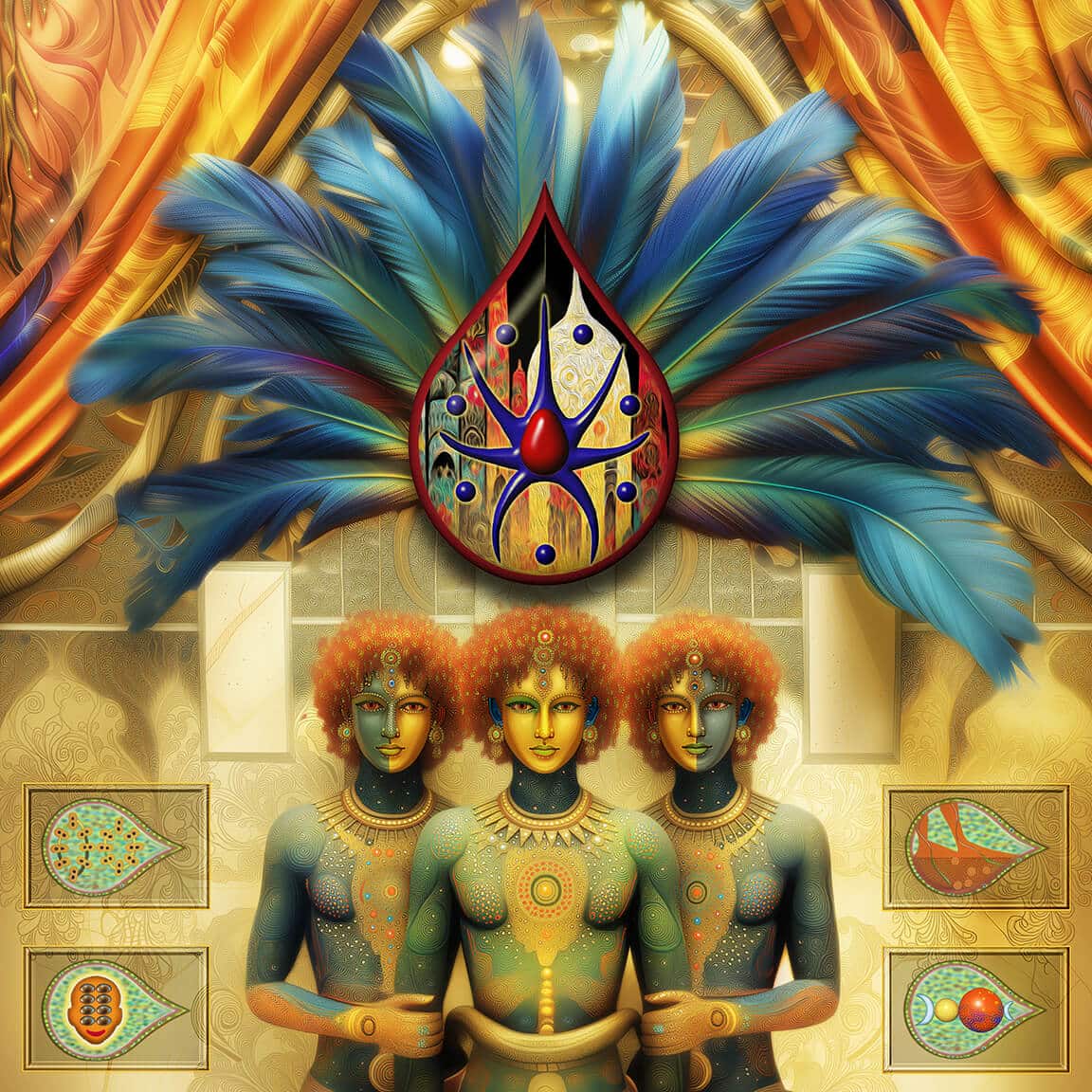
After generations of secret labour, pathways opened for new “Masters” to take the work to the next level and build a foundation within life itself for the perfect society. Their ultimate goal was to form a new culture, with the foundational social unit of a Circle of Eight forming into Clusters and, in turn, into an immense “Cluster-of-Clusters Nation.”
This would be overseen by a Majastas, who would connect with a key member of each circle known as Maja, to gently guide all clusters. They would also possess what now became an elaborate overlay to Raw Life, known as the Living System of Tatchlan.
Author links
Links will open in a new tab.
Pin it to Pinterest!


